OSB Manufacturing, Properties, and Sustainable Applications in Modern Construction
Abstract
Oriented Strand Board (OSB) has emerged as a cornerstone material in contemporary construction and wood-based panel industries. This article examines the manufacturing process, structural characteristics, performance advantages, and environmental sustainability of OSB, positioning it as a viable alternative to traditional plywood and engineered wood products. By analyzing its mechanical properties, market trends, and innovative applications, this study highlights OSB's role in advancing sustainable building practices.
1. Introduction
Oriented Strand Board (OSB), a versatile engineered wood panel, was first commercialized in the late 20th century as a cost-effective and durable substitute for plywood. Composed of aligned wood strands bonded with synthetic resins, OSB leverages the inherent strength of wood fiber orientation to achieve superior load-bearing capacity. Its adoption spans residential, commercial, and industrial sectors, driven by advancements in adhesive technology and sustainable forestry practices.
2. Manufacturing Process
The production of OSB involves four key stages:
-
Raw Material Preparation: Fast-growing, small-diameter logs (e.g., aspen, pine) are debarked and cut into thin rectangular strands.
-
Strand Drying and Blending: Strands are dried to optimal moisture content (2–5%) and mixed with waterproof binders (e.g., phenol-formaldehyde or methylene diphenyl diisocyanate [MDI]).
-
Mat Formation: Strands are layered in cross-oriented directions (face layers longitudinally, core layers transversely) using specialized forming equipment, mimicking the cross-laminated structure of plywood.
-
Hot Pressing: The mat is compressed under high temperature (200–220°C) and pressure (3–5 MPa) to cure resins and achieve target density (600–680 kg/m³).
3. Structural and Mechanical Properties
OSB’s performance is defined by its engineered anisotropy:
-
Strength-to-Weight Ratio: Cross-layered strands enhance dimensional stability and resistance to shear forces, making OSB suitable for load-bearing wall sheathing and roof decking (meeting ASTM D1037 standards).
-
Moisture Resistance: MDI-bonded OSB exhibits low water absorption (<15% after 24-hour immersion), qualifying it for humid environments (e.g., subflooring).
-
Thermal and Acoustic Insulation: OSB’s porous structure contributes to energy-efficient building envelopes.
Comparative Advantages Over Plywood:
-
20–30% lower cost due to efficient raw material utilization.
-
Consistent quality with fewer voids or knots.
-
Higher screw-holding capacity and edge load resistance.
4. Applications in Construction and Beyond
-
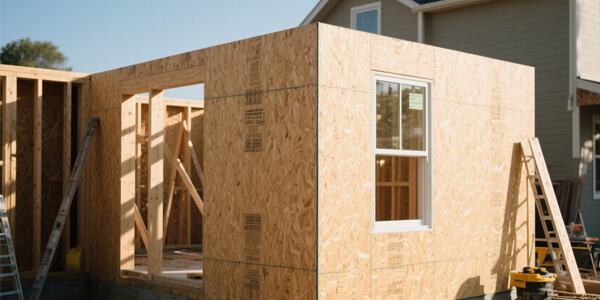
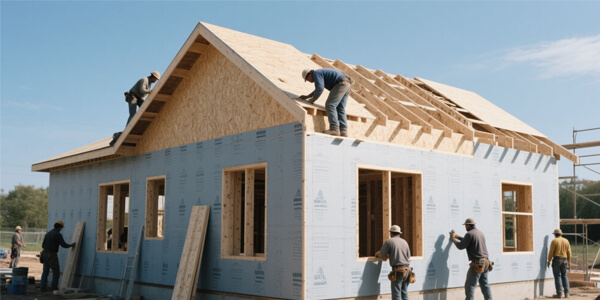
Residential Construction: Widely used for structural panels (e.g., SIPs – Structural Insulated Panels), flooring, and sheathing.
-
Industrial Packaging: Replaces solid wood in crates and pallets due to its uniformity and recyclability.
-
Emerging Trends: Integration with bio-based adhesives and fire-retardant treatments for code-compliant assemblies (e.g., IBC Type III buildings).
5. Sustainability and Environmental Impact
OSB aligns with circular economy principles through:
-
Resource Efficiency: Utilizes 80–90% of log volume, reducing waste compared to sawmill operations.
-
Carbon Sequestration: Wood strands store CO2 throughout the product lifecycle.
-
Certifications: Compliance with FSC (Forest Stewardship Council) and PEFC (Programme for the Endorsement of Forest Certification) ensures responsible sourcing.
Challenges: Emissions from formaldehyde-based resins remain a concern, though MDI and soy-based alternatives are gaining traction.
6. Future Perspectives
Innovations such as OSB/wood-plastic composites (WPCs) and nanocellulose-reinforced panels aim to enhance durability and multifunctionality. Market projections indicate a 5.8% CAGR (2023–2030), fueled by green building codes (e.g., LEED, BREEAM) and prefabricated construction demand.
7. Conclusion
As a high-performance, eco-conscious material, OSB exemplifies the synergy between engineered wood technology and sustainable development. Ongoing research into bio-resins, hybrid composites, and digital manufacturing (e.g., CNC-compatible grades) will further solidify its position in global markets.
References
-
APA – The Engineered Wood Association. (2022). OSB Product Guide.
-
Cai, Z., & Ross, R. J. (2010). Mechanical Properties of Wood-Based Composite Materials. USDA Forest Service.
-
European Committee for Standardization. (2020). EN 300: Oriented Strand Boards (OSB) – Definitions, Classification, and Specifications.
The Ultimate Guide to a Versatile, Cost-Effective Engineered Wood Product
OSB A Comprehensive Guide
Related Article